Hair Oiling: What It Does for Your Hair and How to Do It
Hair oiling is a scalp massage and an oil treatment in one. Here is what each does for your hair, which Ayurvedic herbs matter and how to do a proper champi at home.
In this guide
Hair that feels thinner than it used to, ends that snap, a shine that has gone flat. Hair oiling is India's oldest answer to all three, and researchers have started to look at why it works.
Massage oil into your scalp before a wash and two things happen at once: the massage works on the roots, and the oil protects the lengths. Done every week, hair looks shinier from the first wash and feels stronger and thicker over the months that follow. This guide covers what oiling does, which herbs matter and how to do it properly.
Key takeaways
- Hair oiling is two treatments in one: a scalp massage for the roots and an oil treatment for the lengths.
- In a 24-week study, four minutes of scalp massage a day led to thicker hairs.
- Coconut oil cuts the protein that hair loses in washing, the damage that leaves strands weak and dull.
- Once a week before a wash is enough to start: a teaspoon of oil and your fingertip pads.
What does hair oiling do for your hair?
It does two jobs, and each has research behind it.
The massage works on the roots
Pressing and moving the scalp stretches the cells at the base of each hair. In one study, four minutes a day for 24 weeks left hairs measurably thicker.
The oil protects the lengths
Oil coats each strand, seals in moisture and adds shine. In lab tests, coconut oil reduced the protein that hair loses when it is washed.
The scalp massage study in numbers
The study appeared in the journal Eplasty in 2016. Nine men had one side of the scalp massaged for four minutes a day, and the other side was left alone for comparison.
- 9 men took part
- 4 minutes of scalp massage a day
- 24 weeks of daily massage
After 24 weeks, the average hair on the massaged side measured 0.092 mm across, up from 0.085 mm at the start. It was a small study, but it is the reason scalp massage is now taken seriously.
For the oil, the classic research is a 2003 study in the Journal of Cosmetic Science. Of the three oils tested, coconut oil was the only one that clearly reduced the protein hair loses, whether it went on before the wash or after. Protein loss is what leaves strands weak, rough and dull, so hair that keeps its protein keeps its strength and shine.
Which herbs go into an Ayurvedic hair oil?
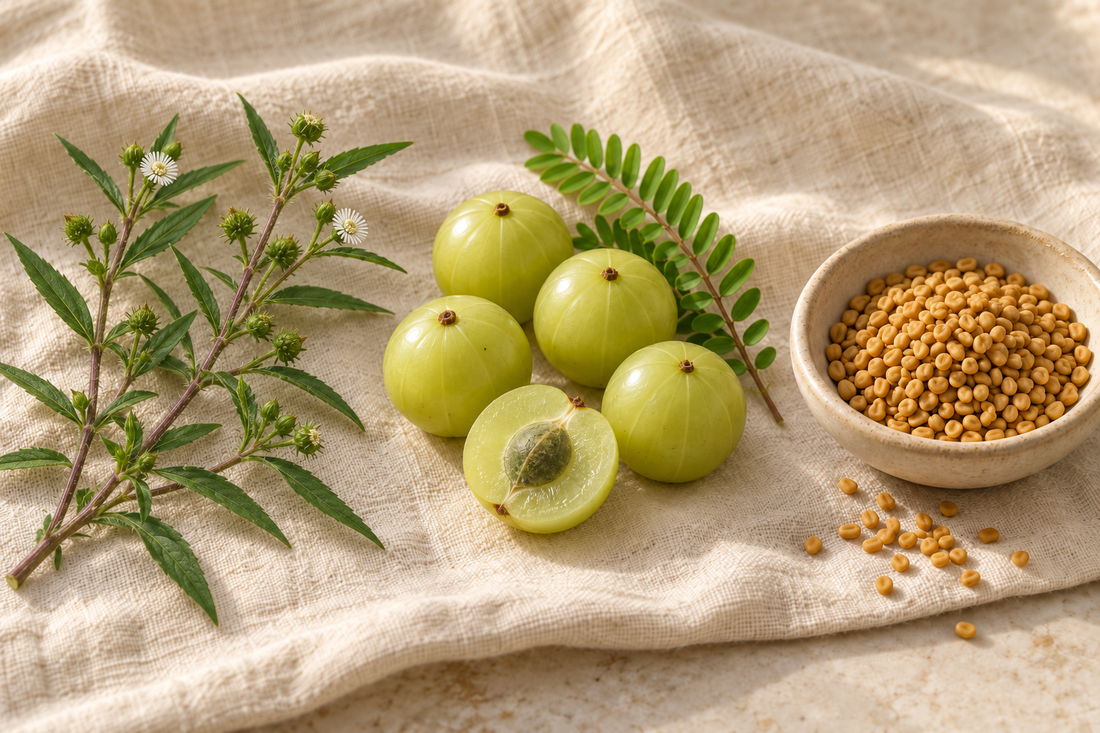
An Ayurvedic hair oil starts with a base oil, often sesame or coconut, and infuses it with herbs. These are the names you will meet most:
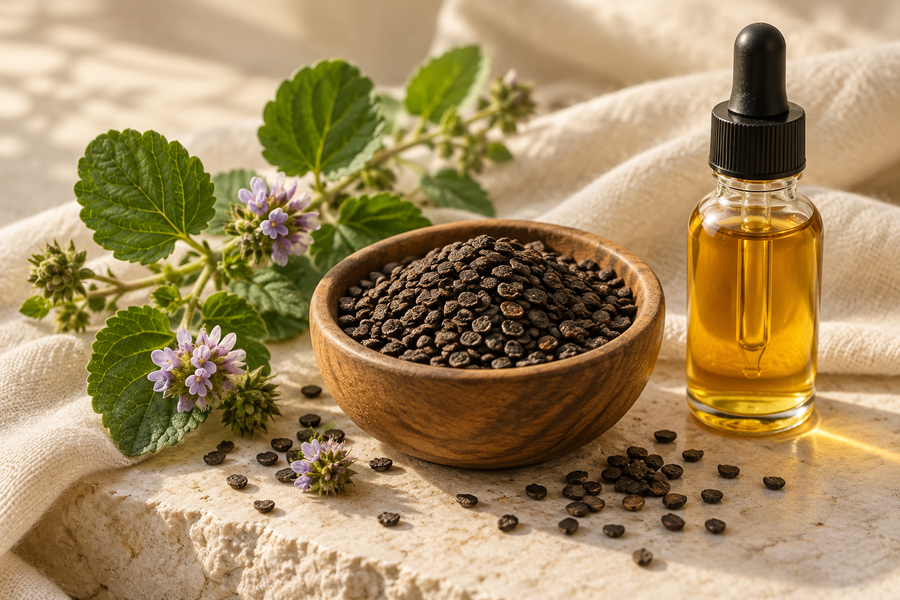
- Bhringraj. The herb that gives mahabhringraj oil, the best-known Ayurvedic hair oil, its name.
- Amla. Indian gooseberry, a staple of Indian hair care for generations.
- Rosemary. The best studied of the group. In a 2015 trial of 100 people with hereditary hair thinning, rosemary oil increased hair count over six months as much as 2% minoxidil did, with less scalp itching.
- Fenugreek and brahmi. Two more herbs of the traditional blends, usually found alongside the others.
How to oil your hair, step by step
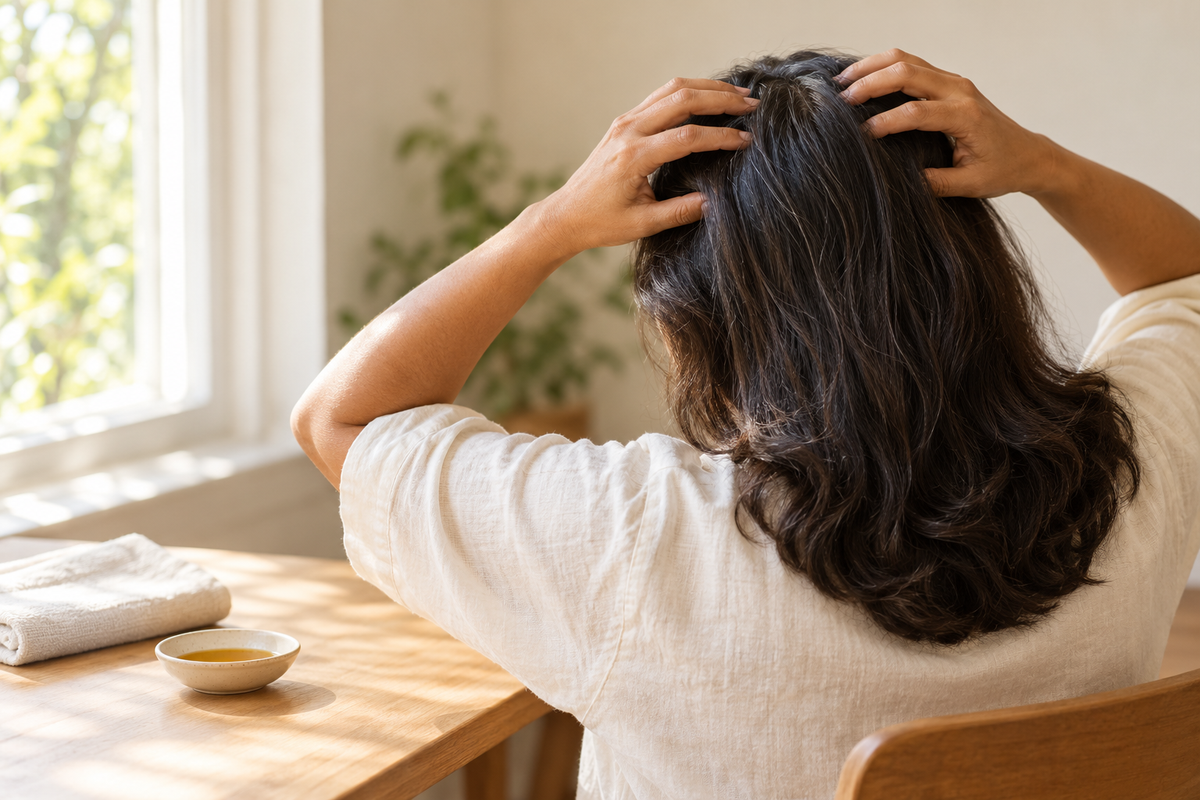
In India, a head massage with oil is known as champi. "Shampoo" comes from the same Hindi root, champna, to press or massage: when the word first appeared in English in 1762, it meant to massage.
- Start dry, with a teaspoon Oil goes on dry, detangled hair before a wash. About a teaspoon covers most scalps. Use it at room temperature, straight from the bottle.
- Part and apply Part your hair down the middle and dab oil along the part with your fingertips. Make a new part a finger's width away and repeat across the scalp.
- Massage with your fingertip pads Press with the soft pads of your fingers, firmly enough to move the scalp. Work in small circles from hairline to crown, then the sides and the nape. Give it at least four minutes, the length used in the study.
- Smooth the rest through the lengths Run what is left on your hands through mid-lengths and ends, where hair is oldest and driest.
- Leave it on Twenty minutes to an hour is enough. Overnight is fine too if you like it.
- Wash it out Use a mild shampoo, and lather twice if your hair still feels coated.
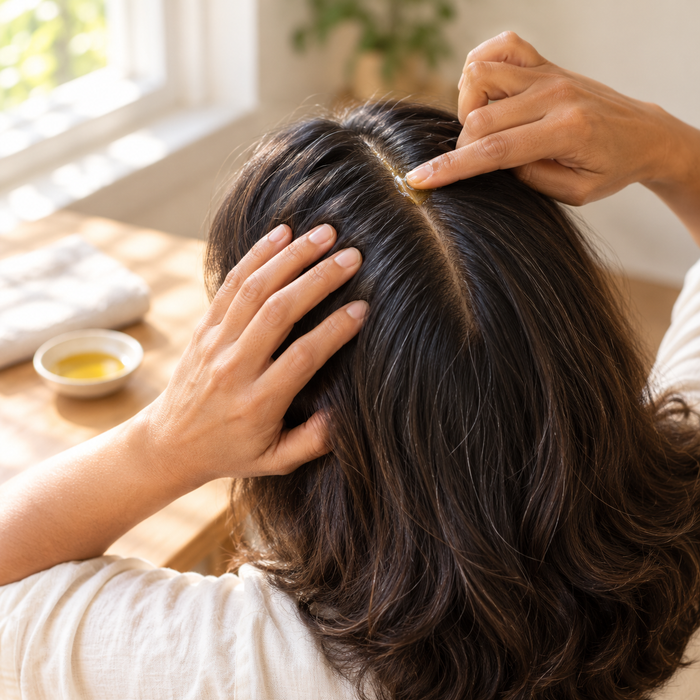
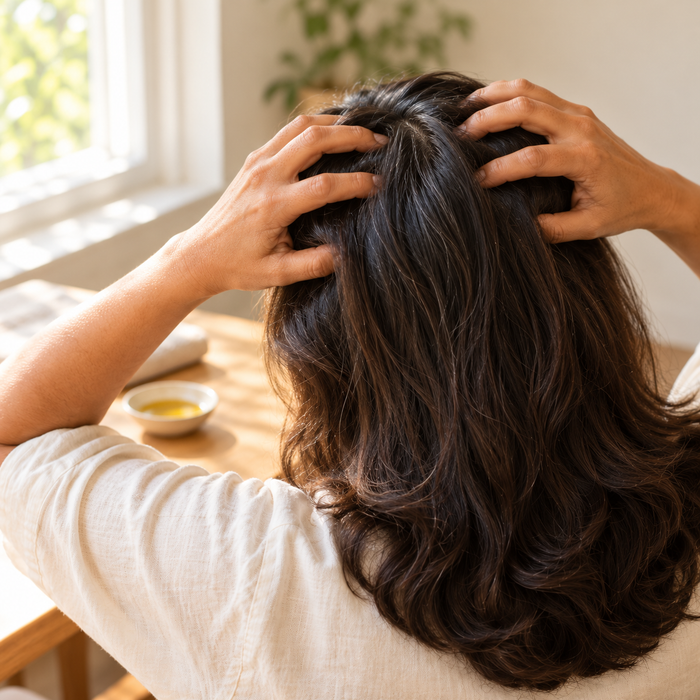
Three things make the difference: a small amount of oil rather than a soaked scalp, finger pads rather than nails, and a loose braid afterward rather than a tight bun.
How often should you oil your hair?
Once a week before a wash is the traditional rhythm and a good place to start. Two or three times a week is fine if your scalp stays comfortable.
If your scalp gets oily quickly or tends to flake, keep the oil on your lengths and ends and do the scalp massage dry. The massage study used no oil at all, so you still get the part that works on the roots.
Where our hair oil fits
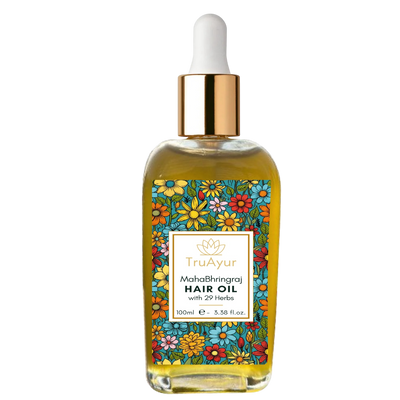
Our MahaBhringraj Hair Oil is made for this ritual. Bhringraj, amla, brahmi and fenugreek are infused into a base of sesame, coconut, castor, olive and avocado oils, with rosemary oil for the scalp and peppermint and camphor for a cool, fresh feel during the massage. A teaspoon is enough for one champi. Use it before a wash, once or twice a week, for hair that looks shinier and feels softer, stronger and thicker.
How long does hair oiling take to work?
Shine comes first. Strength and thickness follow.
- First wash Hair feels softer and looks shinier. That is the oil conditioning each strand.
- Weeks 4 to 12 Hair that loses less protein in the wash holds up better, so lengths start to feel stronger. Keep the weekly rhythm.
- Week 24 The point where the massage study measured thicker hairs.
Oiling rewards the people who keep at it. Four minutes, once a week, is a habit most of us can hold on to.
Sources
- Koyama T, et al. Standardized Scalp Massage Results in Increased Hair Thickness by Inducing Stretching Forces to Dermal Papilla Cells in the Subcutaneous Tissue. Eplasty. 2016;16:e8.
- Rele AS, Mohile RB. Effect of mineral oil, sunflower oil, and coconut oil on prevention of hair damage. Journal of Cosmetic Science. 2003;54(2):175-192.
- Panahi Y, et al. Rosemary oil vs minoxidil 2% for the treatment of androgenetic alopecia: a randomized comparative trial. Skinmed. 2015;13(1):15-21.
- Wesley NO, Talakoub L. Hair oiling: Practices, benefits, and caveats. MDedge Dermatology. September 2020.
- Cleveland Clinic. Hair Oiling: Should You Try It? August 2022.
- American Academy of Dermatology. Do you have hair loss or hair shedding? and Hairstyles that pull can lead to hair loss.
- Merriam-Webster. Shampoo.
Questions people ask
Does hair oiling help hair growth?
Should I leave oil in my hair overnight?
How often should I oil my hair?
Can I oil my hair if I have dandruff or an oily scalp?
Is hair oiling good for fine or thin hair?
Why do I see more hair in the shower after oiling?
This article is for general education and is not medical advice.