Face Oil for Fine Lines: Why It Works and How to Use It
Fine lines look deepest on dry skin. Here is how a few drops of face oil soften them, what the research says about the herbs Ayurveda puts in one, and the three-minute way to use it at night.
In this guide
Fine lines are at their sharpest when your skin is dry: around the eyes by evening, across the forehead in winter, at the corners of the mouth after a long flight. That is not a coincidence, and it is why a face oil is one of the oldest answers to them.
A few drops on damp skin seal in water, so skin looks smoother and more supple by morning. The herbs in an Ayurvedic face oil add to that over the following weeks. This guide covers why oil softens fine lines, what goes into a traditional face oil, what the research says and how to use one at night.
Key takeaways
- Dry skin makes fine lines look deeper. An oil seals water into the skin, so it looks smoother and plumper.
- Ayurveda's classic face oil is built on saffron and licorice in sesame oil, usually with sandalwood.
- In a 60-day placebo-controlled trial, a lotion with ashwagandha root extract improved skin hydration, elasticity and wrinkle scores.
- Three to four drops on damp skin and two to three minutes of massage, every night.
Why do fine lines look deeper on dry skin?
Mayo Clinic puts it simply: dry skin shrivels plump skin cells, which can lead to fine lines and wrinkles. Skin also becomes drier and less elastic with age.
The reverse holds too. Moisturizing traps water in the skin, and skin that holds water looks smoother. A face oil does that job in two parts:
Water goes in
Cleansing, a hydrating serum or a light lotion leaves water in the top layer of your skin.
Oil keeps it there
Plant oils form a thin protective layer on top. A 2018 research review found that this lets skin hold on to its moisture and lose less water.
That is why a face oil goes on while your skin is still damp. Harvard Health notes that oil-based moisturizers contain no water of their own, so they work best on skin that does.
What goes into an Ayurvedic face oil?
Ayurveda has been oiling the face for a very long time. The Ashtanga Hridaya, one of its classical texts, records a saffron oil called kumkumadi tailam, and it is still used on the face today, above all for an even, bright complexion.
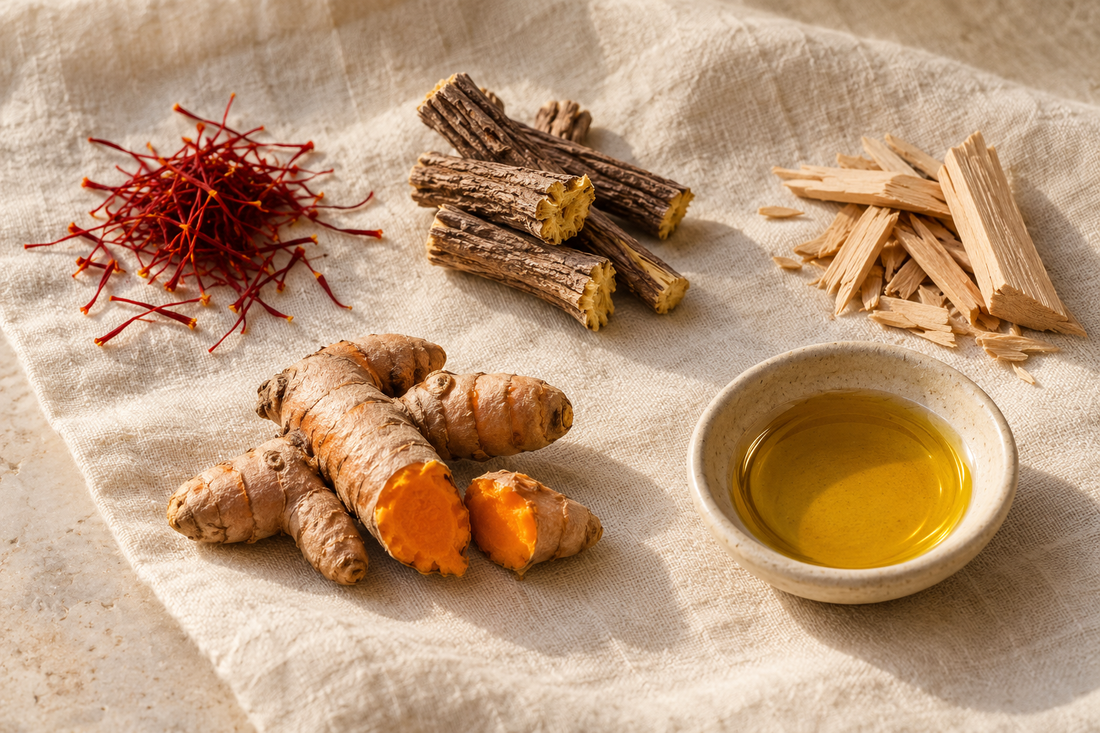
The heart of the recipe has not changed across the classical versions: saffron and licorice in a base of sesame oil, with sandalwood in most of them and turmeric in later ones. Sandalwood and licorice also appear among the ten herbs the Charaka Samhita names for the complexion.
What does the research say about these ingredients?
The strongest trial so far is on ashwagandha, the root better known as a stress supplement. In a 2023 study in the journal Cureus, 56 adults used either a lotion with 8% ashwagandha root extract or a placebo lotion on the face twice a day for 60 days. Neither they nor the dermatologist grading their skin knew who had which.
- 56 adults took part
- 60 days of twice-daily use
- 20.7% more skin hydration
With ashwagandha, skin hydration rose by 20.7%, against 9.5% with placebo, and elasticity by 16.3%, against 3.7%. The dermatologist's scores for wrinkles, pores and brightness also improved more than with placebo.
The other herbs have research behind them too:
- Licorice. Its compounds glabridin and liquiritin have been tested in several small clinical trials for uneven skin tone. A 2018 review counts licorice extract among the most promising natural ingredients for it.
- Turmeric. A review of 18 clinical studies found early evidence that turmeric and its active compound, curcumin, may benefit skin health.
- Saffron and sandalwood. The oldest names on the list, prized in Ayurveda for the complexion. Saffron also lends an oil its golden color, and sandalwood its scent.
These were studies of single ingredients in lotions and creams, which is how skincare research is usually done. What they show is that the herbs Ayurveda chose centuries ago have earned their place in a modern routine.
How to use a face oil at night
Evening is the natural time for it. Your skin is clean, nothing has to sit under makeup and the oil has the whole night ahead of it.
- Cleanse and leave your skin damp Use a mild cleanser, then pat your face until it is just damp. If you use a hydrating serum, it goes on now.
- Three to four drops Put the oil in your palm at room temperature and spread it across your fingertips. Press it onto cheeks, forehead, chin and neck.
- Massage for two to three minutes Light pressure, upward and outward strokes: collarbone to jaw, along the jawline to the ears, corners of the mouth toward the temples, center of the forehead outward. Avoid the eye area.
- Finish and sleep On very dry skin, a night cream can go on top. Wear sunscreen the next morning.
Ayurveda calls daily oil massage abhyanga, and the Charaka Samhita describes skin that becomes smooth and firm with regular practice. Using a night cream as well? The oil goes on first and the cream on top. Our guide to bakuchiol vs retinol covers what to look for in one.
Where our facial oil fits
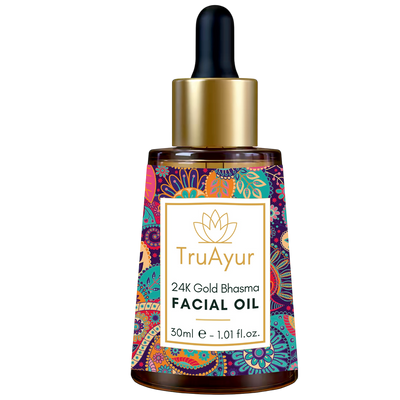
Our 24K Gold Facial Oil follows that classical pattern. Saffron, licorice and sandalwood sit in a base of sesame and sweet almond oil, joined by ashwagandha, turmeric, white turmeric, nagkesar and 24K gold bhasma, a traditional Ayurvedic preparation of gold. Three to four drops are enough for face and neck. It is made to be the last step of your evening, for skin that looks smoother, brighter and more supple by morning.
How soon will you see a difference?
Some of it shows the next morning, and some of it builds.
- The first morning Skin feels softer and looks smoother. That is sealed-in moisture at work.
- A few weeks The American Academy of Dermatology says to give a moisturizer a few weeks to work. This is when dryness lines start to stay soft through the day.
- Day 60 The point at which the ashwagandha trial measured its gains in hydration and elasticity.
Whichever week you are in, it works when you do it every night.
Sources
- Narra K, et al. A Study of Efficacy and Safety of Ashwagandha (Withania somnifera) Lotion on Facial Skin in Photoaged Healthy Adults. Cureus. 2023;15(3):e36168.
- Lin TK, et al. Anti-inflammatory and skin barrier repair effects of topical application of some plant oils. International Journal of Molecular Sciences. 2018;19(1):70.
- Hollinger JC, et al. Are Natural Ingredients Effective in the Management of Hyperpigmentation? A Systematic Review. Journal of Clinical and Aesthetic Dermatology. 2018;11(2):28-37.
- Vaughn AR, et al. Effects of Turmeric (Curcuma longa) on Skin Health: A Systematic Review of the Clinical Evidence. Phytotherapy Research. 2016;30(8):1243-1264.
- Ravi A, et al. A Comprehensive Review on Kumkumadi Thaila. International Journal of Ayurveda and Pharma Research. 2023;11(11):61-66.
- Mayo Clinic. Wrinkles.
- Harvard Health Publishing. 9 ways to banish dry skin.
- American Academy of Dermatology. How to select anti-aging skin care products.
- Charak Samhita Online. Abhyanga and List of herbs in Charak Samhita.
Questions people ask
Does face oil help with fine lines?
Does face oil go on before or after moisturizer?
How many drops of face oil should I use?
Can I use face oil every night?
Will face oil make my skin break out?
Can I use a face oil with retinol or bakuchiol?
This article is for general education and is not medical advice.